
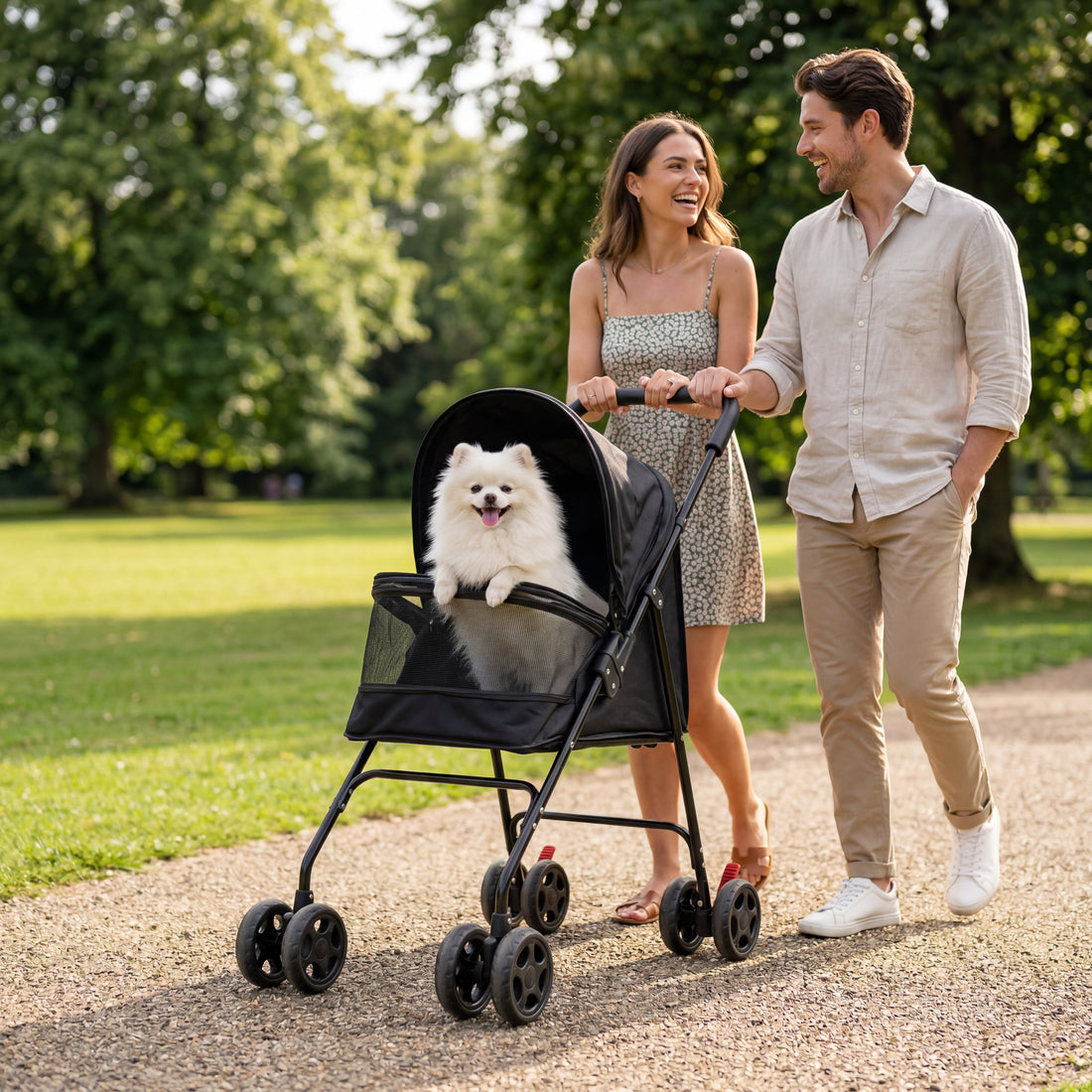
Once you've decided a stroller is worth it, the actual choosing is where most people get stuck. Every listing reads roughly the same, so it helps to know which specs actually matter once you're out on a real walk, not just in a product photo.
Check the maximum load against your pet's actual weight, not just their breed
Most pet strollers, including ours, are built around a 15kg (33lb) capacity, which comfortably covers everything from a Chihuahua to a French Bulldog. That's a solid range for most small and mid-size dogs, cats, and other small pets, but it's still worth weighing your pet rather than guessing from breed alone. A dog at the upper end of "small" can creep close to that limit faster than expected.
Don't assume every stroller handles rough ground the same way
Four wheels sound like four wheels, but how they're built changes the ride. Smooth-rolling wheels are made for pavements, parks and the in-between ground most walks actually happen on. If your regular route is mostly pavement with the odd grassy park, that's the right fit. If you're planning serious off-road trail walking, it's worth checking the specific wheel type before assuming any stroller will manage it equally well.
Look for a wheel lock, not just wheels
This is an easy detail to overlook and an important one. A wheel lock keeps the stroller stationary the moment you stop, whether that's to chat, cross a road, or let your pet settle. Without one, a stroller can drift on a slope or roll when you least want it to.
Mesh canopy plus a raincover, not one or the other
A mesh canopy keeps your pet shaded and lets air move freely, which matters on warmer days. But British weather doesn't stay warm for long, so check whether a raincover is actually included rather than sold separately. Ours comes with one as standard, precisely so a sudden downpour doesn't have to end the walk early.
Fold-down size and assembly effort
This is the detail that quietly decides whether a stroller gets used regularly or ends up folded in a cupboard after a few outings. Look for one that folds flat for hallway or boot storage, and check whether assembly needs tools. Ours is designed for easy, tool-free assembly, so it's ready to go straight out of the box rather than requiring a screwdriver and twenty minutes before the first walk.
A cup holder is a small thing that matters more than it sounds
Not a dealbreaker, but worth having: somewhere to put your coffee, keys, or phone frees up a hand for the leash, the lead of another dog, or just steering the stroller itself.
Read the safety basics, and actually follow them
Every stroller worth buying will come with the same core guidance: never leave your pet unattended in it, always engage the wheel lock when stationary, stay within the maximum load, and keep clear of traffic and road edges. It's not exciting copy, but it's the difference between a stroller that's genuinely safe and one that just looks safe in photos.
The short version
Match the weight limit to your pet's real weight, check the wheel lock is there, make sure a raincover is included rather than an add-on, and pick one that folds down and assembles without a fight. Everything else is secondary to those four.

